They look intricate, with their elegant crescent shape and airy, layered pastry that curls and flakes with every bite. Break one open and a cascade of buttery flakes falls away, leaving your fingers deliciously greasy.
You might assume this kind of baking belongs to professionals or to the French. But it doesn’t. Good croissants can be made at home, even if you’re not a seasoned pastry chef.
First, a warning: it’s a bit of a faff. The process requires time, planning and a degree of precision. Everything needs to be rolled out evenly, squared up, cut neatly, rested and chilled. It’s not overly complicated, but it rewards patience and careful technique.
So what’s in a croissant? Mainly butter. Lots of it. There’s dough too, but the magic is in the layers of butter trapped between sheets of pastry. Laminated dough means butter is rolled thinly between layers of dough, then folded repeatedly to multiply the layers. In the oven the layers separate and the butter soaks into the dough, creating the flaky, light texture croissants are known for.
Begin with the detrempe, the dough. Combine 1 kg strong white bread flour, 10 g fast-action yeast, 20 g salt and 140 g caster sugar with 330 ml warm water and 330 ml warm milk. The dough will be soft and sticky, so a mixer with a dough hook is useful—knead for about ten minutes until smooth.
Cover the detrempe with clingfilm and rest it in the fridge overnight. This long, cold rest allows the dough to ferment slowly and develop flavor.
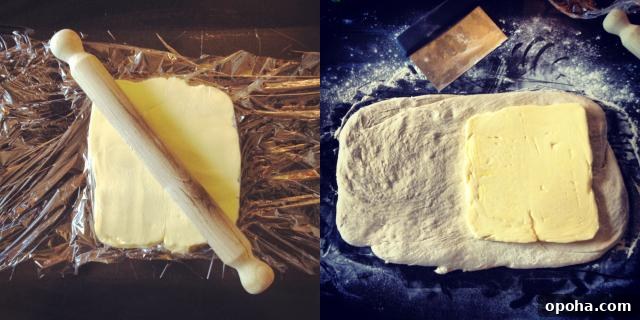
The next morning, take 500 g of butter from the fridge to soften slightly; it should remain cool but workable. Lay clingfilm on the work surface, place the butter in the center, cover with more clingfilm and use a rolling pin to beat and flatten it into a square about 1 cm thick. Trim the edges to make the square neat and even.
Roll the dough into a rectangle just over twice the size of the butter square, leaving an extra couple of centimetres around the edges. Place the butter on one side of the dough and remove the clingfilm. Fold the other half of the dough over the butter and use a rolling pin to seal the three open edges firmly. You now have a block of butter enclosed in pastry.
Now the rolling and folding begins. Roll the pastry until it is twice as long as before, then fold each end in by one-sixth, and fold again by another sixth so the folds meet in the middle. Turn the dough over so you have a stack of eight layers, press the edges to seal, wrap and chill in the fridge for an hour.
The next roll-out is the big one. Clear a large, well-floured surface and aim for a sheet roughly 140 cm by 50 cm, dusting underneath to prevent sticking. Be gentle to avoid tearing the layers or letting the butter break through; if the dough is too firm, rest it at room temperature for 10–15 minutes to soften slightly.
Trim the sheet to exactly 140 cm by 50 cm and cut it lengthways into two strips of 140 by 25 cm. On each strip, mark 20 cm intervals along one edge, then stagger marks on the opposite edge by 10 cm. Use a pizza cutter to connect the marks and form neat triangles with a 20 cm base—about twenty-four in total.
Roll each triangle from the broad base toward the peak, tucking the tip underneath so it stays put. Curve the ends slightly inward to create the classic crescent shape.
Place the croissants on baking trays with space between them and let them proof for at least a couple of hours, until nearly doubled in size.
Brush the croissants with beaten egg and bake at 200°C for ten minutes, then reduce the oven to 170°C and bake for an additional five to ten minutes. Watch them carefully; high-fat pastries can brown quickly. If the edges darken too fast, tent with foil.
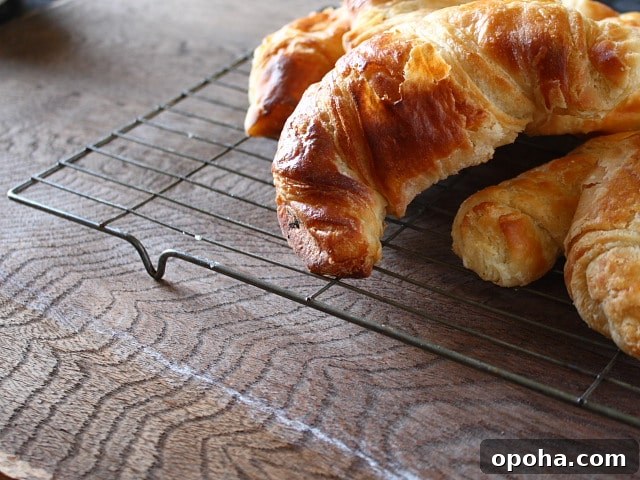
Eat at least one while it’s still warm—croissants are at their best straight from the oven. Leftovers can be refreshed in a low oven or given a short blast in the microwave when required.
This method combines techniques used by a number of respected bakers and yields rich, flaky croissants suitable for home bakers prepared to invest the time and care the process requires.